Beginner roller skating
Why the Powerslide Beats a T-Stop on a Hill
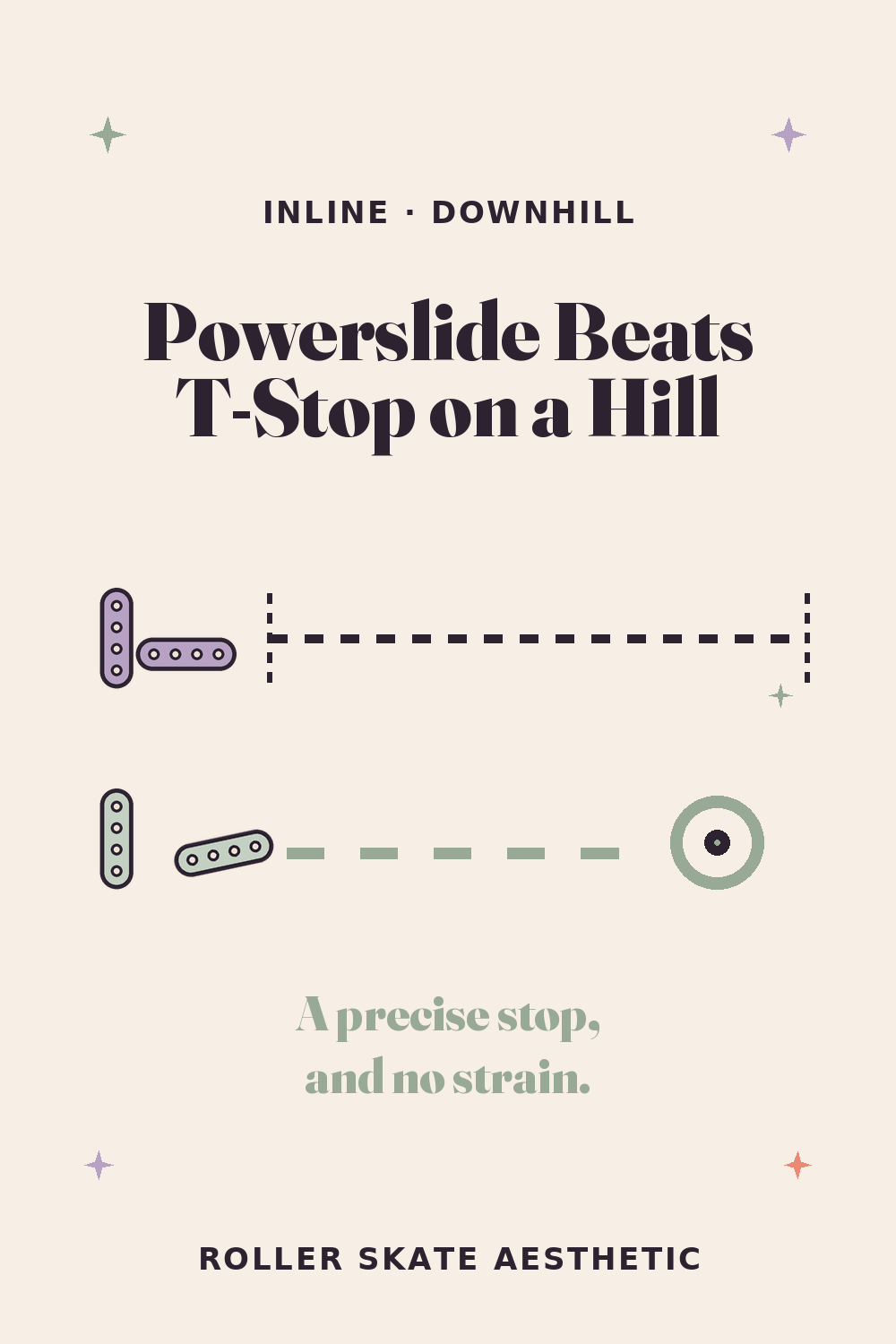
On a slope, a certified coach rates the powerslide as by far the most effective stop of those relying on technique rather than hardware: it stops you at a precise point, and it does not strain your muscles the way a T-stop does when held against a gradient. Precision and no strain are the two things a hill takes from you. Steeper than my stops? I ride it out — Cass. Technique from ICP-certified coach Asha Kirkby.
On a flat road most stops are interchangeable enough. A gradient sorts them, because it keeps feeding speed in while you are trying to take speed out.
Of the stops that rely on technique rather than hardware, a certified coach rates the powerslide as by far the most effective on a slope. Two reasons, and they are the two things a hill takes away from you: it stops you at a precise point, and it does not strain your muscles.
The strain point is the one people underestimate. Holding a T-stop against a gradient is a sustained muscular effort — the longer the hill, the more it asks, and a leg that is tiring is a leg that lets the angle drift.
Precision is the other half. A stop that fades out somewhere in the next twenty metres is fine on an empty path and useless at a junction. The powerslide puts the end of the movement where you chose it.
I stop in a T myself, so this is written about my own default, not somebody else's.
One thing sits above all of this, and it is mine rather than hers: a hill I doubt I can stop on, I ride it out rather than brake. Trying to brake halfway down a gradient you have already misjudged is worse than riding it to the flat — Cass, a non-professional street skater.
Technique from Asha Kirkby of Skatefresh, an instructor certified by the Inline Certification Program. She teaches inline skating, and that is the discipline this page is about.
Keep going: this is one section of the full Roller Skating for Beginners guide — sizing, gear, stopping, and where to skate, in one page. Free, no sign-up, nothing to buy.