Beginner roller skating
Turn Your Toes In Further With Every Single Step
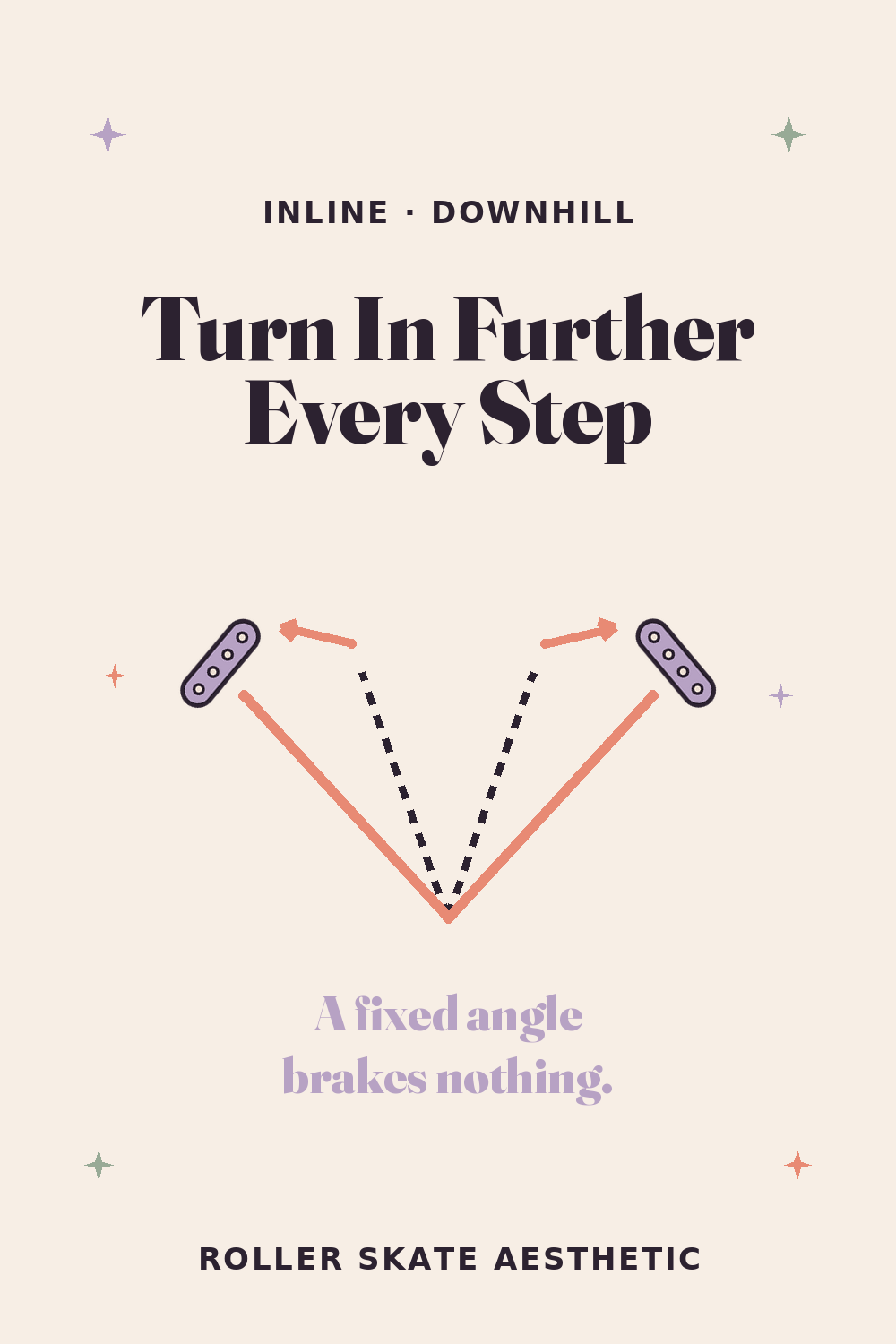
On a hill, a fixed toe angle is why a plough feels like it does nothing. A certified coach's progression: start each stop around 20 to 30 degrees of toe-in, and increase it with every step until you are near 45 at the last one. Sharp inversion plus a low knee bend is what makes stopping force on a steep slope. A hill past that, I ride it out instead — Cass. From ICP-certified coach Asha Kirkby.
The second half of why a plough does nothing on a hill is the angle, and specifically the fact that most people pick one angle and keep it.
A fixed toe-in produces a fixed amount of friction, and a slope keeps adding speed to it. Holding 20 degrees all the way down is not a stop, it is a mild tax on your acceleration.
The progression a certified coach teaches: start around 20 to 30 degrees of toe-in, then turn the toes further in with every step, reaching something near 45 degrees at the last one. The stop tightens as you slow.
Sharp inversion plus a low knee bend is the combination. Either one alone underdelivers on a steep slope — deep knees with parallel feet slide, sharp angles with straight legs skip. It is the pair that produces stopping force.
One thing sits above all of this, and it is mine rather than hers: a hill I doubt I can stop on, I ride it out rather than brake. Trying to brake halfway down a gradient you have already misjudged is worse than riding it to the flat — Cass, a non-professional street skater.
Technique from Asha Kirkby of Skatefresh, an instructor certified by the Inline Certification Program. She teaches inline skating, and that is the discipline this page is about.
Keep going: this is one section of the full Roller Skating for Beginners guide — sizing, gear, stopping, and where to skate, in one page. Free, no sign-up, nothing to buy.